

Addington Water Tower was built in 1883 to provide a high pressure water system for the Addington Railway Workshops. These workshops were established in 1879 - 1880, replacing the first railway workshop in New Zealand, which had been established by the Canterbury Provincial Government in 1863. The water tower was designed by Peter Ellis, the then Chief Draughtsman for the Railways Department. Ellis's brother was the foreman during its construction and prison labour was used to build it.
The tower is 21.9 metres high and is built of steel reinforced concrete and cast iron. It is significant within the history of engineering as one of the earliest structures in the world to be made from reinforced concrete. This significance was acknowledged by the Institute of Professional Engineers, New Zealand (IPENZ) in 1990, which provided a plaque for the tower.
The tower stands on a three-step pedestal, and is visually divided into three sections. The bottom section is built of reinforced concrete and is square in plan. There are arched recesses on each of the four sides, and circular windows are set in the top of each recess. On the north-east face there are two wooden doors. The middle section, also of reinforced concrete, and the top section, which consists of the cast-iron water tank, are both octagonal in plan and are separated by a projecting cornice. Health and safety slogans, such as 'Safety Week Starts Every Monday', once decorated every second face of the tank. Inside the tower there are timber floors on both the ground and first floor level, with a steel ladder providing access to the latter. The pumping mechanism is situated on the ground floor. As the tower was constructed on a base of quicksand and clay, it had sunk approximately 22 centimetres (9 inches) by the time it was completed (as predicted by Ellis), and now rests on a slight angle.
The primary significance of the tower is the method and materials used in its construction. Today Addington Water Tower is also important as the last remaining physical link to the Addington Railway Workshops, which had 'once been the largest industrial concern in the South Island'. The buildings of the workshops were demolished during the 1980s and a new railway station now stands on this land. The tower remains as a prominent and distinctive feature of this landscape.
The tower is 21.9 metres high and is built of steel reinforced concrete and cast iron. It is significant within the history of engineering as one of the earliest structures in the world to be made from reinforced concrete. This significance was acknowledged by the Institute of Professional Engineers, New Zealand (IPENZ) in 1990, which provided a plaque for the tower.
The tower stands on a three-step pedestal, and is visually divided into three sections. The bottom section is built of reinforced concrete and is square in plan. There are arched recesses on each of the four sides, and circular windows are set in the top of each recess. On the north-east face there are two wooden doors. The middle section, also of reinforced concrete, and the top section, which consists of the cast-iron water tank, are both octagonal in plan and are separated by a projecting cornice. Health and safety slogans, such as 'Safety Week Starts Every Monday', once decorated every second face of the tank. Inside the tower there are timber floors on both the ground and first floor level, with a steel ladder providing access to the latter. The pumping mechanism is situated on the ground floor. As the tower was constructed on a base of quicksand and clay, it had sunk approximately 22 centimetres (9 inches) by the time it was completed (as predicted by Ellis), and now rests on a slight angle.
The primary significance of the tower is the method and materials used in its construction. Today Addington Water Tower is also important as the last remaining physical link to the Addington Railway Workshops, which had 'once been the largest industrial concern in the South Island'. The buildings of the workshops were demolished during the 1980s and a new railway station now stands on this land. The tower remains as a prominent and distinctive feature of this landscape.
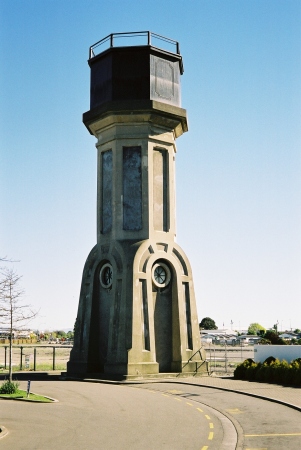
Addington Water Tower | Melanie Lovell-Smith | 01/09/2001 | Heritage New Zealand Pouhere Taonga
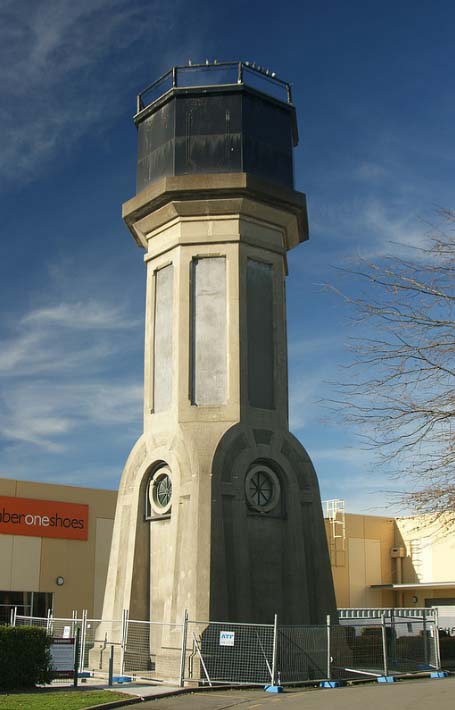
Addington Water Tower. Image courtesy of www.flickr.com | PhilBee NZ - Phil Braithwaite | 21/07/2013 | Phil Braithwaite
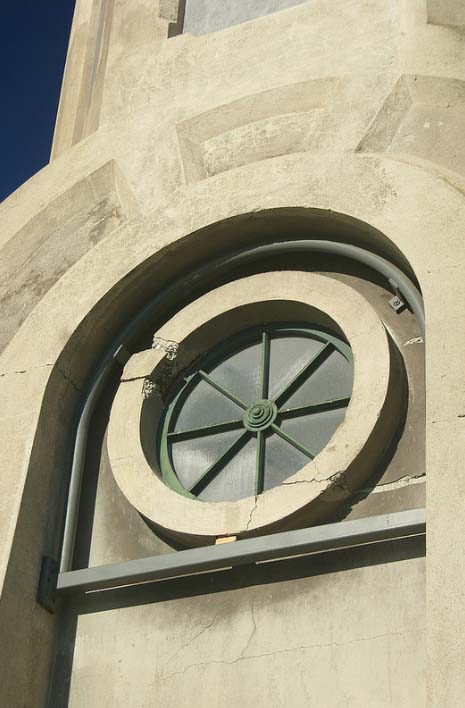
Addington Water Tower. Detail. Image courtesy of www.flickr.com | PhilBee NZ - Phil Braithwaite | 21/07/2013 | Phil Braithwaite
Addington Water Tower | Melanie Lovell-Smith | 01/09/2001 | Heritage New Zealand Pouhere Taonga
Addington Water Tower. Image courtesy of www.flickr.com | PhilBee NZ - Phil Braithwaite | 21/07/2013 | Phil Braithwaite
Addington Water Tower. Detail. Image courtesy of www.flickr.com | PhilBee NZ - Phil Braithwaite | 21/07/2013 | Phil Braithwaite
